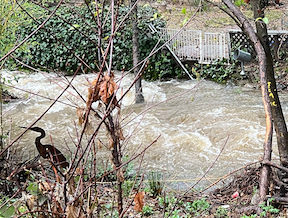
Normally a pretty quiet little creek. Goes to show what a little rain can do.
You might be able to discern that I’m adding these previews in reverse, and as a result, I may be a little less informative the farther back I go, because I’ve already described some of the same issues in “later” summaries that I’ve already completed. Oh well. Don’t sue me.
A defendant whose now-invalid enhancement for prior prison terms is eligible for full resentencing under section 1172.75 even if the enhancement was not executed;
Sometimes the law restricts whether an enhancement can be imposed in addition to some other enhancement;
On resentencing under section 1172.75, the trial court must seriously deal with the expectations of section 1385, subdivision (c), and its mandate that the court give great weight to listed factors;
A court erred by instructing the jury on when a defendant fails to explain, when the defendant did not actually do so;
Criminal protective orders apply to protect only victims, not those who were not victims.
When looking at the gold dust on Case 000024, you may wonder what some of the holdings have to do with the extraneous enhancement for great bodily injury. He was also convicted of murder in another count. I have included dust from that discussion, in which the court affirmed the conviction because the error was harmless. Many cases have errors but are affirmed because the court determined that the error did not affect the outcome. The lesson we can take from that is that we really need to treat the question of prejudice seriously. The California constitution mandates that no conviction can be reversed unless there is a miscarriage of justice. A finding that the error did not likely affect the result is a finding that there was no miscarriage of justice.
Case: 000023
Defendants whose enhanced prison prior term or terms were stayed at sentencing are eligible for resentencing under section 1172.75.
First Holding: Defendants whose enhanced prison prior term or terms were stayed at sentencing are eligible for resentencing under section 1172.75 [See] People v. Rhodius (2025) 17 Cal.5th 1050.
Second Holding: The Legislature declared legally invalid any prior-prison-term enhancements imposed before January 1, 2020, except those arising from convictions for sexually violent offenses, and provided for resentencing under Penal Code section 1172.75. [See] SB 136 (2019-2020 Reg. Sess., Stats. 2019, ch. 590, § 1); SB 483 (2021-2022 Reg. Sess., Stats. 2021, ch. 728, § 3); PC 1172.75.
Case: 000024
For the attempted murder of the victim in count 3, the trial court should have stayed the three-year enhancement for great bodily injury under section 12022.7 because it also imposed a term of 25 years to life under section 12022.53, subdivision (d), for personally and proximately causing great bodily injury with a firearm. We will modify the judgment so that it accords with the law. (People v. Hunter (1986) 184 Cal.App.3d 1531, 1537 [“Where multiple prison terms are improperly imposed as in this case, the reviewing court may modify the sentence to stay imposition of the sentence”].)
First Holding: It is improper to impose the enhancement under Penal Code section 12022.7 in addition to enhancement under section 12022.53, subdivision (d), and it must be stayed [See] PC 12022.53, subd. (f); People v. Garcia (2017) 7 Cal.App.5th 941, 949; People v. Hunter (1986) 184 Cal.App.3d 1531, 1537.
Second Holding: If an error violates a defendant’s federal constitutional rights, reversal is required unless the error was harmless beyond a reasonable doubt. [See] People v. Hernandez (2011) 51 Cal.4th 733, 745; Chapman v. California (1967) 386 U.S. 18, 24; People v. Canizales (2019) 7 Cal.5th 591, 615; People v. Concha (2010) 182 Cal.App.4th 1072, 1087.
Third Holding: A harmless error analysis may include consideration of implausible defense testimony and closing argument to the jury. [See] People v. Fayed (2020) 9 Cal.5th 147, 195 ; People v. Zambrano (2004) 124 Cal.App.4th 228, 243; People v. Flores (2016) 2 Cal.App.5th 855, 881.
Fourth Holding: With respect to errors alleged regarding the conviction of the murder, the error can be found to be harmless beyond a reasonable doubt even under the Chapman standard, as the court concludes in this instance. [See] People v. Salas (2006) 37 Cal.4th 967, 983-984 ; People v. Garcia (2001) 25 Cal.4th 744, 755 ; Wright v. West (1992) 505 U.S. 277, 296; Hanrahan v. Thieret (7th Cir. 1991) 933 F.2d 1328, 1340; Phelps v. Duckworth (7th Cir. 1985) 772 F.2d 1410, 1413-1414.
Fifth Holding: The standard of review on sufficiency of evidence is whether any rational trier of fact could have found the essential elements of the crime or special circumstance beyond a reasonable doubt, viewing evidence in light most favorable to prosecution. [See] People v. Zamudio (2008) 43 Cal.4th 327, 357.
Sixth Holding: Substantial evidence is evidence that is “reasonable, credible, and of solid value.” [See] People v. Zamudio (2008) 43 Cal.4th 327, 357.
Seventh Holding: A conviction for attempted murder requires proof that the defendant intended to kill the victim and proof of a direct but ineffectual act toward accomplishing that goal. But a finding of willfulness, deliberation, and premeditation requires more than a showing of an intent to kill. [See] People v. Medina (2019) 33 Cal.App.5th 146, 153; People v. Gomez (2018) 6 Cal.5th 243, 282.
OTHER HOLDINGS: [NOTE BY GARY–THIS CASE HAD NUMEROUS OTHER GEMS, AND I HAVE PUT THE ADDITIONAL PRINCIPLES IN THIS ONE PARAGRAPH, FOLLOWED IN THE NEXT PARAGRAPH BY THE AUTHORITIES (KEYED TO THE ROMAN ENUMERATION OF THE MULTIPLE ADDITIONAL PRINCIPLES).] i. As for premeditation and deliberation, the five-second pause between the shootings gave the defendant a chance to reflect, evidence of planning; ii. The manner of the shooting also reflects deliberation and premeditation, because the defendant fired multiple shots at a fleeing victim, not a single shot during a direct confrontation; iii. attempted murder is not divided into degrees, but greater punishment if premeditated; iv. A criminal defendant can clarify a misunderstanding concerning a jury’s verdict in the trial court and failure to object to form of verdict forfeits objection of technical error in the form; v. attempted petty theft with a prior conviction, is a“ ‘non-crime,’ ” because in essence, it is impossible to attempt to commit a crime that has a prior conviction as an element”; vi. There can be a logical contradiction inherent in the concept of certain offenses, including “attempted involuntary manslaughter”; vii. To bring a successful appellate challenge to the sufficiency of the evidence, a defendant “must set forth in his opening brief all of the material evidence on the disputed elements of the crime in the light most favorable to the People, and then must persuade us that evidence cannot reasonably support the jury’s verdict; viii. When reviewing a claim the trial court erred in denying a motion for a judgment of acquittal (§ 1118.1) that was made at the close of the prosecution’s case-in-chief, the appellate court considers the evidence “as it stood at that point”; ix. it is the appellant’s burden to demonstrate error “based on the appellate record and with meaningful legal analysis [with adequate citation to the record]”; ix. The type of evidence sufficient to sustain a finding of premeditation and deliberation falls into three basic categories: (1) planning, (2) motive, and (3) manner of killing. But these are not the exclusive means for establishing premeditation and deliberation. And they “need not be present in any particular combination to find substantial evidence of premeditation and deliberation”; x. The opinion sets forth various examples of planning; xi. Arguments not raised below are forfeited; xii. The court conducts de novo review to detemine if jury miscontrued or misapplied the law; xiii Error in failing to instruct the jury on a lesser included offense is harmless when the jury necessarily decides the factual questions posed by the omitted instructions adversely to defendant under other properly given instructions; xiv. errors in abstract may be corrected.
ADDITIONAL AUTHORITIES [NOTE BY GARY: THESE ARE THE SUPPORTING AUTHORITIES FOR THE NUMERIOUS PRINCIPLES SET FORTH IN THE PREVIOUS PARAGRAPH.][See] i. People v. San Nicolas (2004) 34 Cal.4th 614, 658; ii. People v. Boyd (1985) 38 Cal.3d 762, 769-770 and People v. Lunafelix (1985) 168 Cal.App.3d 97, 102; iii. People v. Favor (2012) 54 Cal.4th 868, 876-877; People v. Solis (2015) 232 Cal.App.4th 1108, 1113, fn. 2; see § 664, subd. (a); iv. People v. Johnson (2015) 61 Cal.4th 734, 784; People v. Bean (1989) 213 Cal.App.3d 639; vi. People v. Robins (2020) 44 Cal.App.5th 413; vii. People v. Sanghera (2006) 139 Cal.App.4th 1567, 1574; viii. People v. Cole (2004) 33 Cal.4th 1158, 1212-1213; viii. People v. Dauterman (2024) 104 Cal.App.5th 603, 609; ix. People v. Anderson (1968) 70 Cal.2d 15, People v. Lenart (2004) 32 Cal.4th 1107, 1127, and People v. Stitely (2005) 35 Cal.4th 514, 543; x. People v. Young (2005) 34 Cal.4th 1149, 1183, People v. San Nicolas, supra, 34 Cal.4th at p. 658, Gomez, supra, 6 Cal.5th at p. 282, People v. Brady (2010) 50 Cal.4th 547, 564; xi. People v. Richardson (2008) 43 Cal.4th 959, 1022-1023; xii. People v. Carrington (2009) 47 Cal.4th 145, 192, People v. Shaw (2002) 97 Cal.App.4th 833, 838; xiii. People v. Lewis (2001) 25 Cal.4th 610, 646; xiii. People v. Mitchell (2001) 26 Cal.4th 181.
Case: 000025
The California Department of Corrections and Rehabilitation notified the court that the defendant was entitled to resentencing under Penal Code section 1172.75. He contends the court did not comply with the requirements of section 1385, subdivision (c), as amended. We agree. Accordingly, we vacate the sentence and remand the matter for further proceedings. There was no discussion at the resentencing hearing in this case of whether dismissal of one or more of the firearm enhancements would endanger public safety.
First Holding: Penal Code section 1385, subdivision (c) requires the court to give great weight to listed factors. [See] Penal Code section 1385.
Second Holding: “Endanger public safety’ means there is a likelihood that the dismissal of the enhancement would result in physical injury or other serious danger to others. [See] Section 1385, subdivision (c)(2).
Case: 000026
Because of error in instructing the jury with CALCRIM 361, we reverse the convictions and remand for further proceedings. The trial court erred by instructing the jurors with CALCRIM No. 361 because the defendant’s testimony did not represent a complete failure to explain or deny incriminating evidence, nor did he claim a lack of knowledge about something incriminating that he could reasonably be expected to have known.
First Holding: It is error to instruct on failure to explain or deny where defendant did not fail to explain or deny [See] People v. Cortez (2016) 63 Cal.4th 101.
Second Holding: We review a claim of instructional error de novo [See] People v. Parker (2022) 13 Cal.5th 1, 66; People v. Cole (2004) 33 Cal.4th 1158, 1217.
Third Holding: That there was a prior hung jury may be persuasive on the question of the prejudice from the error [See] People v. Soojian (2010) 190 Cal.App.4th 491, 520.
Fourth Holding: The Court did not need to determine whether Chapman or Watson standard of review applied, as the error was not harmless under either standard.
Case: 000027
The court struck the name of the minor’s mother from the criminal protective order because she was not a victim of defendant’s crimes. The court also granted an additional credit of five days for time served.
Holding: A protective order cannot be issued to cover those not a victim of defendant’s crime [See] PC 136.2(i)(1); People v. Lopez (2022) 75 Cal.App.5th 227, 236-237; People v. Walts (2025) 112 Cal.App.5th 127.